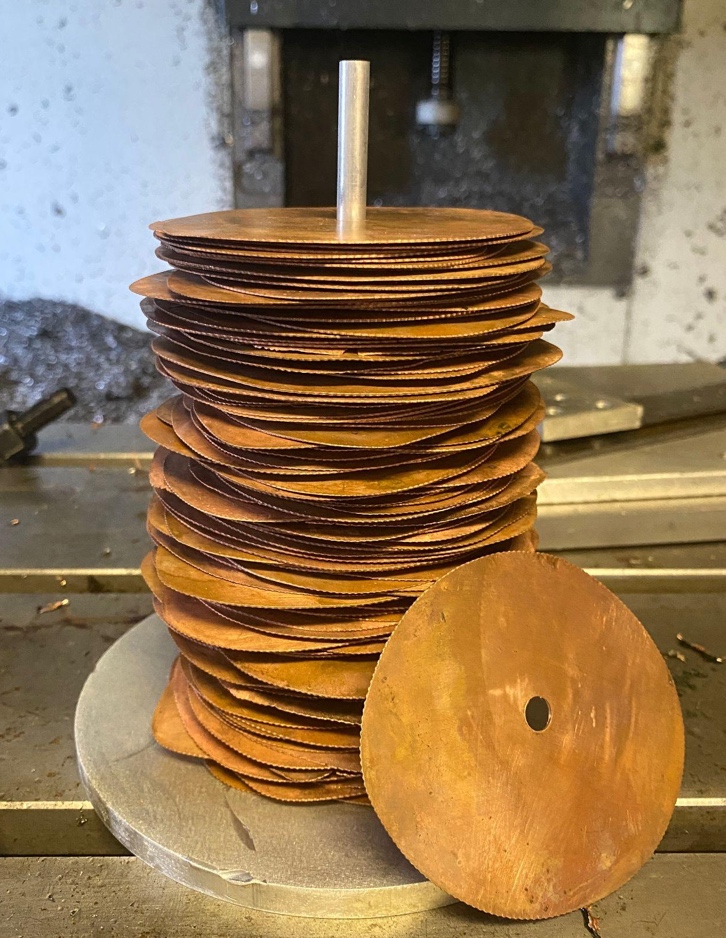
How much space was between each plate?
Height of the plates is calculated by computing the sum of the thickness of plates and the "voids" (the space between them) and then multiplying by the number of plates calculated for that particular combination. Because absolute flatness in metalworking is unachievable, when thin plates are stacked, small voids exist between them due to surface irregularities.
While it is not known exactly how the plates in the sealed portion were sealed, it seems reasonable to suppose that the process of sealing would compress the void space between the sealed plates to some degree.
To better understand the voids between the plates, as a proxy for the plates, 165 copper discs were formed, stacked, and measured. The copper discs were formed from 1 troy oz. 99.9% pure copper rounds by a process that included machine rolling, hammering, annealing, stress relieving, and descaling.
The discs were flattened to an irregular oval shape with an approximate average thickness of 0.020". A hole was drilled into the center of each disc to facilitate stacking onto an aluminum rod.
The resting height of the stack is approximately 5.1". The calculated resting void is approximately 55%, which is to say that due to the irregularities in the flatness of the discs, the stack of discs is 55% higher than a theoretical stack of 165 discs of 0.020" thickness. Manual compression was applied, resulting in a measured height of 4.7", resulting in a calculated void of approximately 42%.